
Melissa, One Year On: where the money went, and who is still waiting, by Annieth Woollery, Independent writer.
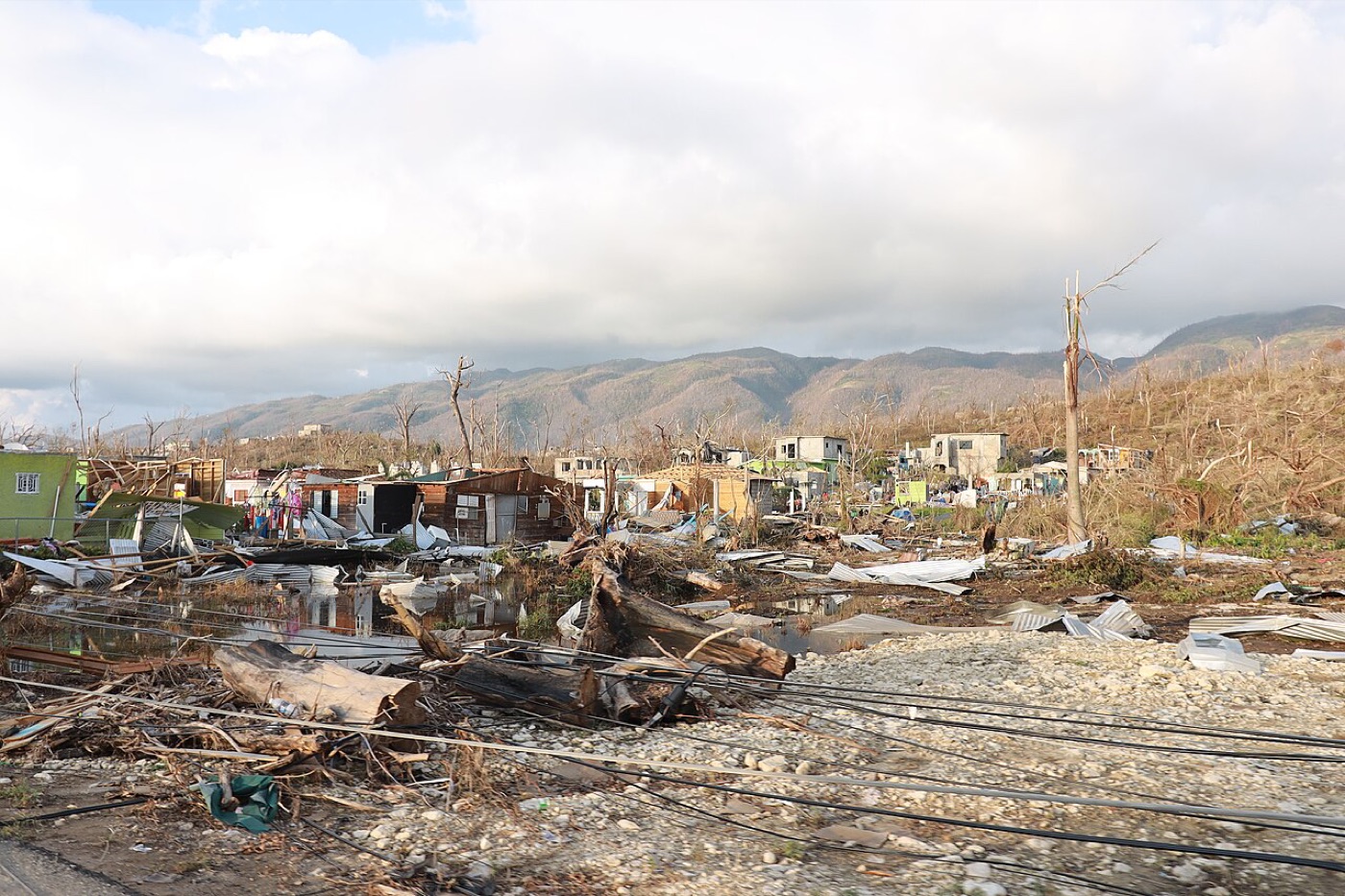
On Tuesday 28 October 2025, Hurricane Melissa crossed Jamaica as a Category 5 storm, killing at least 45 people. The Planning Institute of Jamaica later put total damage, losses and additional costs at J$1.952 trillion (US$12.2 billion), equivalent to 56.7 per cent of our gross domestic product. Within five weeks, five development partners had announced a package of up to US$6.7 billion over three years, the loan package which this site argued last December must be managed with discipline and transparency.
Next Tuesday marks one year. The Associated Press reported on 1 October that about 20 hotels remain closed, and that the biggest obstacle to recovery is not materials or labour but insurance. Hotel owners say claims are slow and settled short. Prime Minister Andrew Holness has warned he may use legislative authority to force faster settlements. So, at Kingstonmouth.com, we ask the real question: one year on, where has the money gone, and who is still waiting for it?
Recent Developments
The official mood has shifted more than once. The Bank of Jamaica's (BOJ) earlier estimate was that full recovery would take three to four years. In February 2026, Governor Richard Byles shortened that to two to three years, citing a faster rebound in agriculture and quicker restoration of electricity and telecoms. By its September 2026 meeting, however, the BOJ's Monetary Policy Committee was warning that risks to growth are "skewed to the downside", pointing to an agricultural supply shock, tourism capacity constraints and mining problems, and it now expects growth to strengthen only in 2027/28 as "reconstruction intensifies".
Tourism, which the AP notes accounts for up to 35 per cent of GDP and more than half of foreign exchange earnings, shows the same mixed picture. In September, Deputy Director of Tourism Phillip Rose said about 70 per cent of the room stock hit by Melissa had been recovered, with more than 11,000 rooms due back between 2026 and early 2027. Yet the Jamaica Hotel and Tourist Association (JHTA) says 28 per cent of hotels have still not reopened.
Where the Money Went
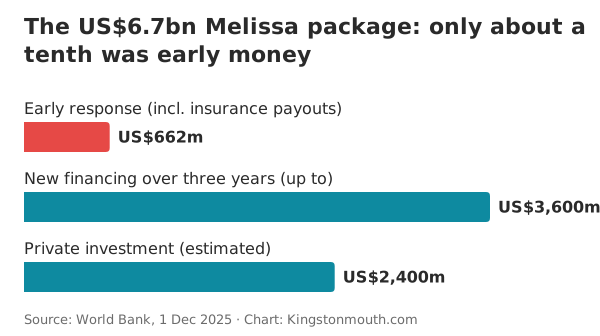
The honest answer is that some money moved fast and much of it is still on paper. Jamaica's disaster-risk insurance worked: CCRIF paid US$91.9 million within weeks of the storm, and the World Bank catastrophe bond paid out in full, US$150 million. On 16 January 2026, the IMF approved a US$415 million emergency disbursement. These were real, early dollars.
But the headline US$6.7 billion is a ceiling, not a cheque. According to the World Bank's announcement, it combines US$662 million in early response (including those insurance payouts and contingent credit), up to US$3.6 billion in new financing from CAF, the Caribbean Development Bank, the IDB, the IMF and the World Bank over three years, and an estimated US$2.4 billion in private investment. Much of the new money is lending that Jamaicans must repay. We could find no public, consolidated account of how much of the package has actually been drawn down and spent. That, in our view, is the problem.
The signs on smaller pots are not reassuring. The Auditor General found that ODPEM had received J$1.44 billion in cash donations by 23 February 2026, but had spent only J$26.2 million, or 1.8 per cent. The Government's defenders said the audit also showed more than J$11 billion committed to 420 relief and recovery contracts, and argued that careful spending is not the same as idle money. Both things can be true. But a family under a tarpaulin does not experience "prudence"; it experiences waiting.
Who Is Still Waiting
Hotel workers and owners. The JHTA's September survey found that only 39 per cent of tourism claimants had been fully settled and paid. Seven in ten reported deductions above what they understood their policy's "average clause" allowed, and about a third said deductions exceeded 40 per cent of their claim. JHTA President O'Brian Heron put it plainly: "Claims are being paid slowly and settled short, and that leaves a working-capital hole across the sector."
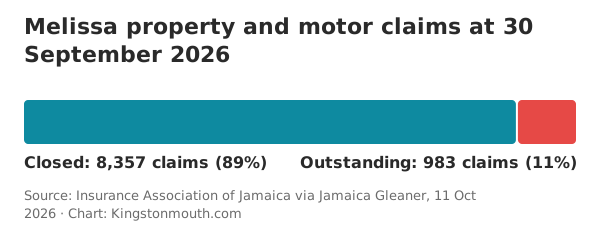
Households and small firms. The Insurance Association of Jamaica reports J$54.35 billion paid across 9,340 property and motor claims, with 983 still outstanding at 30 September. Motor claims are almost done; engineering claims are only 55.2 per cent settled. Nearly three-fifths of payouts went to St James alone, while St Elizabeth, badly hit, received little, which the industry links to low insurance cover. A survey commissioned by the St Elizabeth Homecoming Foundation, reported by Nationwide News, found that just 1.4 per cent of Black River businesses were insured, and none had yet received a payout. For them, insurance reform is irrelevant; only grants and cheap credit will help.
The National Housing Trust has done better: by June it had processed 3,835 claims worth about J$7 billion, disbursed about J$2.85 billion and issued more than 5,000 home repair grants. Mr Holness rightly praised it, and challenged private insurers to follow suit: "Paying up the insurance is critical to the national recovery."
Small farmers. In May, Agriculture Minister Floyd Green told Parliament that some farmers had still not received any support, and announced a J$250 million second phase aimed at those missed the first time. A US$50 million programme for storm-hit smallholders, funded by the Green Climate Fund with the FAO, was due to roll out in September. More than six months after the storm is a long time to wait for seed and fertiliser when your income is the next crop.
What Must Happen Now
Government. Threats of legislation make headlines; deadlines make recoveries. In our view the Government should publish, every month, how much of the US$6.7 billion has been drawn, from whom, on what terms, and where it was spent, parish by parish. If insurers miss the timelines they set themselves (the industry promised to settle most non-litigated claims by the end of September, and did not), then Parliament should legislate for statutory settlement deadlines and interest on late payments. Holness has threatened it. He should table a bill or say plainly why he will not.
Insurers. The industry's own data show the gap. The JHTA has asked insurers to publish how many commercial claims remain open and to give every outstanding claimant a named contact and a written timeline. That is a modest request, and it should be met this month. The Financial Services Commission, which has been reviewing complaints about the average clause, should publish its findings before the winter season, not after.
The Opposition. At the PNP conference in Savanna-la-Mar on 20 September, Mark Golding called for a public reconstruction dashboard, saying "The people must be able to see where the money is going and where the work is being done for the money." We agree. But the opposition declined the Government's offer of a Joint Select Committee last November, preferring a wider national task force. If it will not sit on that committee, it must use the committees it already has, including the Public Administration and Appropriations Committee, which it chairs, to demand the drawdown figures in public sessions. Oversight is a duty, not a slogan.
The Way Forward
For us, the test of Melissa's recovery is not the number of five-star rooms reopened by December, welcome as those jobs are. It is whether a small shopkeeper in Black River, a yam farmer in St Elizabeth and a family in Westmoreland can say, honestly, that help reached them. Borrowed money must be repaid by all Jamaicans. That gives every Jamaican the right to know where it went.
We said last December that this loan must be a bridge, not a burden. One year on, the bridge is half-built, and too many people are still standing on the wrong side of the river. Government, insurers and opposition alike must now show their working. Jamaica's recovery, and its trust in its institutions, depends on it.
Annieth Woollery is a contributing writer for Kingstonmouth.com. Kingstonmouth.com has published independent commentary on Politics, Human Rights and International Development for over ten years. Readers wishing to comment may contact us at kingstonmouth63@gmail.com or on our Facebook and X pages.
Sources
- Jamaica struggles to recover a year after Hurricane Melissa hit as peak tourism season looms — Associated Press (via The Boston Globe), 1 October 2026
- IMF approves US$415 million disbursement for Jamaica to address the impact of Hurricane Melissa — Jamaica Gleaner (CMC), 19 January 2026
- IMF Executive Board Approves a US$415 Million Disbursement to Jamaica — IMF, 16 January 2026
- Holness wants insurers to fast-track Hurricane Melissa claims — Jamaica Gleaner, 5 June 2026
- Jamaica secures a package of up to US$6.7 billion over three years — World Bank, 1 December 2025
- BOJ Projects Full Economic Recovery Within Two to Three Years After Hurricane Melissa — JIS, 25 February 2026
- Summary of Decisions – September 2026 — Bank of Jamaica, September 2026
- Ja recovers 70% of tourism room stock hit by Melissa, over 11,000 more expected back by 2027 — Jamaica Gleaner, 14 September 2026
- Six in 10 tourism insurance claims still unresolved — Jamaica Gleaner, 28 September 2026
- Insurers pay $54b in Melissa claims, 983 outstanding — Jamaica Gleaner, 11 October 2026
- Insurance companies 'taking forever' on claims payouts hampering Melissa recovery – PM — Nationwide 90FM, 11 September 2026
- CCRIF Announces 2nd Payout of US$21.1 Million to Jamaica Following Hurricane Melissa — CCRIF, 6 November 2025
- Jamaica to receive full $150m payout from parametric cat bond after Hurricane Melissa — Artemis, 7 November 2025
- Jamaica audit finds only 1.8% of Hurricane Melissa donations spent months after storm — Caribbean National Weekly, 13 May 2026
- $250 million for Phase 2 of Hurricane Melissa Recovery programme — Jamaica Observer, 17 May 2026
- US$50 Million Agriculture and Resilience Programme Rolls Out September — JIS, 30 May 2026
- Golding demands transparency in western Jamaica hurricane recovery — Jamaica Gleaner, 20 September 2026
- Gov't, Opposition Clash On Oversight Plan For Hurricane Recovery — Radio Jamaica News, 12 November 2025
- Borrowing at a Crossroads: why Jamaica must manage the US$6.7 billion Loan Package with Discipline and Transparency — Kingstonmouth.com, 4 December 2025