
Reform UK Stumbles: What 'Defending the Indefensible' Means for Black Britain, by Annieth Woollery, Independent writer.
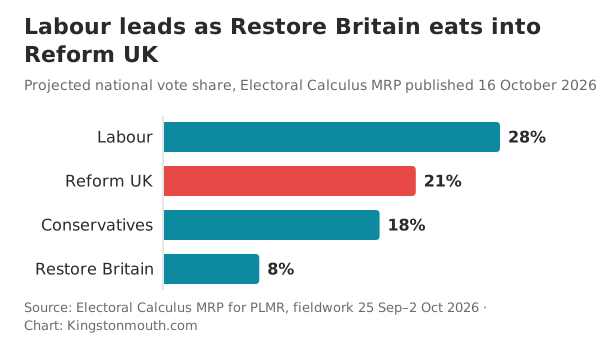
For much of the past year, Nigel Farage's Reform UK looked like the party most likely to form Britain's next government. This autumn the picture has changed. An Electoral Calculus MRP poll published on 16 October 2026, commissioned by PLMR, puts Labour on 28 per cent, Reform UK on 21 per cent and the Conservatives on 18 per cent, with Rupert Lowe's Restore Britain on 8 per cent. In the same series, Reform stood at 31 per cent in January. In the same week, ITV News published the findings of a year-long undercover investigation inside Reform's Westminster headquarters, in which the party's own director of communications, Ed Sumner, told a new recruit: "You have to start defending the indefensible."
For Black British and Caribbean-heritage readers, the polling numbers matter less than what the footage reveals about how a party that hopes to govern deals with racism in its own ranks. At Kingstonmouth.com, we ask the real question: if Reform is falling, is the politics it brought into the mainstream falling with it, or simply changing shape?
Recent Developments
Britain has had a turbulent year. Keir Starmer announced on 22 June 2026 that he would step down as Labour leader, less than two years after winning a large majority. Andy Burnham was confirmed unopposed as Labour leader and became Prime Minister on Monday 20 July 2026, promising outside Downing Street a "circuit breaker for Britain" and admitting that "we have not been good enough and we need to be better."
The first electoral test came in Starmer's old seat. In the Holborn and St Pancras by-election on 8 October 2026, Labour's Sagal Abdi-Wali won with 12,292 votes (45.2 per cent), ahead of Green Party leader Zack Polanski on 8,928 (32.8 per cent), on a turnout of 38.76 per cent. Reform finished behind the Conservatives. Inner London was never Reform's natural ground, but it was hardly a result to suggest an unstoppable force.
Then came the national poll. Electoral Calculus projects Labour winning 353 seats and a majority of 56, the Conservatives returning as the official opposition on 90 seats, and Reform falling to third on 81. Martin Baxter of Electoral Calculus said Restore Britain "is cutting into Reform's vote and leaving it with fewer than 100 seats and even less than the Conservatives." One point of fairness is important: the fieldwork for that poll ran from 25 September to 2 October, before the ITV investigation was published. Reform's slide began before the cameras were switched on.
What the Undercover Footage Shows
The ITV Exposure documentary, Undercover: A Year in Reform, made by Hardcash Productions, followed a reporter who secured a job in Reform's Westminster press office. ITV News published its findings on 15 October, and the 90-minute film was scheduled for ITV1 and ITVX on Sunday 18 October.
The case that concerns our readers most involves Chris Parry, a former Reform mayoral candidate for Hampshire and the Solent. According to Searchlight's account of the investigation, Parry had posted that David Lammy, then Deputy Prime Minister, "must go home to the Caribbean where [his] loyalty lies", and had questioned the loyalty of eight other prominent Black and Muslim politicians. In the footage, Ed Sumner is reported to have called Parry "clearly a racist" and to have expected him to be removed. Weeks later, Parry was still in the party. Mr Farage is recorded saying: "He must apologise to Lammy, if David Lammy's taken offence." Sumner's reply, as reported, was: "You're protecting him."
Parry has defended himself. He described the post as an "ironic comment" made before he joined Reform, and said it concerned Mr Lammy's stance on reparations and his Caribbean identity, not race. Reform later suspended him and, according to ATV Today, has not published the outcome of its investigation.
The film also includes other allegations: a councillor registered on a white-only dating site who was not suspended, a would-be candidate who said he had twice failed vetting before being allowed to stand (which Reform denies), and local figures advising a candidate to delete posts supporting Tommy Robinson. These remain allegations from an undercover film, and they should be read as such.
The Party's Response
Reform UK has not stayed silent. In statements reported alongside the investigation, the party said: "There is no room for racism in Reform UK." It said investigations had begun, some members had been suspended and vetting had been "improved and prioritised", while accepting that "a handful of individuals who do not share our values will initially make it through vetting."
Supporters argue that every large and fast-growing party picks up some bad apples, and that Reform is being judged more harshly than others. Critics counter that the problem shown here is not who slipped through vetting, but what happened once senior staff knew. When a party's own communications director calls a candidate "clearly a racist" and the leader settles for an apology, it is a choice, not a vetting failure. In our view, that is the heart of the story.
What This Means for Windrush Families
The Parry post matters because of the words used. "Go home to the Caribbean" was said to a man born and raised in Britain. Many people from the Windrush generation and their children and grandchildren have heard those words in the street, at work or at the school gate. When they come from someone seeking to run a region, and the party leader's answer is an apology "if" offence was taken, the message to Black Britons is that belonging is conditional.
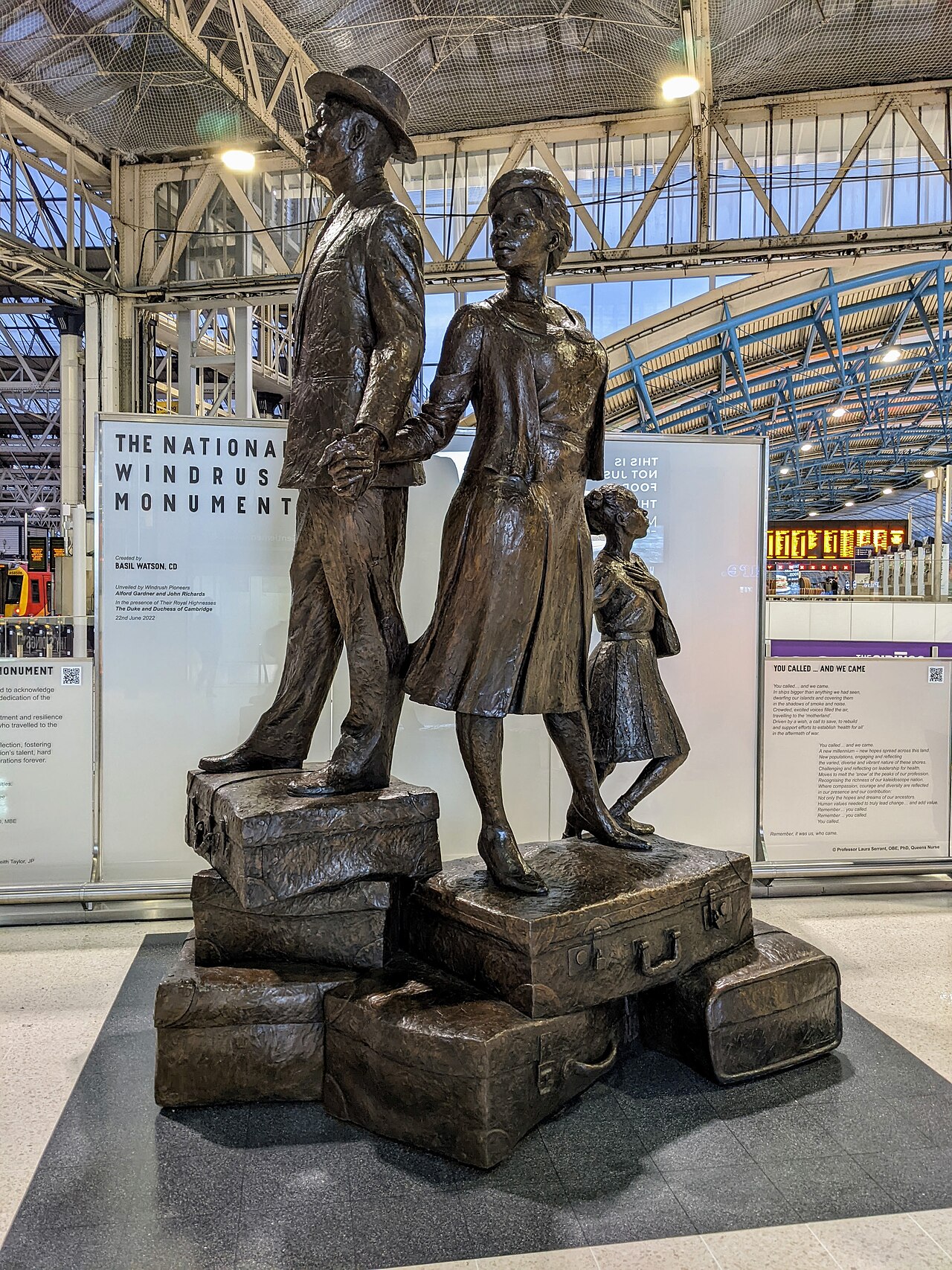
Policy matters as much as tone. In September 2025 Reform announced plans to abolish indefinite leave to remain, requiring settled migrants to reapply for visas under tougher rules, and to bar anyone who is not a British citizen from welfare. Immigration lawyers called the plan "outrageous" and warned it would retrospectively remove the status of people who had settled lawfully. Caribbean families have seen this before. The Windrush scandal showed how lawful residents could be treated as outsiders when the state lost sight of their rights, and the Home Office's own Windrush Lessons Learned Review, by Wendy Williams, was laid before Parliament in March 2020. We believe any proposal to take settled status away retrospectively should be judged against that history.
Why Reform's Slide Is Not the End of the Story
It would be a mistake to celebrate too early. A poll that moves votes from Reform to Restore Britain does not shrink the vote for hard-line immigration politics; it divides it. Electoral Calculus's September poll, commissioned by Restore Britain itself, found that 40 per cent of Reform voters said they were likely to vote for Lowe's party. Combined, Reform and Restore Britain still take 29 per cent in the October poll, higher than Labour alone. The argument has not been won. It has only fragmented.
What the New Prime Minister Must Deliver
Mr Burnham has promised the "biggest changes of the past 40 years". For Black British and Caribbean-heritage communities, we would judge him on three points. First, finish the job on Windrush: compensation that reaches people while they are still alive, and a Home Office culture that treats settled residents as citizens, not suspects. Second, set out an immigration policy that is firm, fair and honest about Britain's dependence on workers from the Caribbean and Commonwealth, rather than chasing Reform's language. Third, tackle the cost-of-living and regional inequality he has named as priorities, because disillusionment is what Reform and Restore Britain feed on.
For us, the lesson of the past month is clear. Racism is not defeated because one party slips in the polls. It is defeated when leaders refuse to defend the indefensible, whichever party they belong to. Reform has questions to answer about what its leadership knew and when. Labour now has a majority, a new leader and no excuses. Black Britain is watching, and so is the Caribbean.
Annieth Woollery is a contributing writer for Kingstonmouth.com. Kingstonmouth.com has published independent commentary on Politics, Human Rights and International Development for over ten years. Readers wishing to comment may contact us at kingstonmouth63@gmail.com or on our Facebook and X pages.
Sources
- Reform officials admit they 'defend the indefensible' after allegations against party figures — ITV News, 15 October 2026
- ITV reveal more details on investigation of Reform UK's racism and extremism concerns — ATV Today, 15 October 2026
- ITV blows up Reform UK racism with undercover sting — Searchlight, 16 October 2026
- Nigel Farage secretly filmed defending Reform candidate accused of racism over David Lammy remarks — International Business Times UK, 16 October 2026
- Reform officials admit they 'defend the indefensible' in explosive undercover footage — The Daily Britain, 15 October 2026
- MRP Poll October 2026 — Electoral Calculus, 16 October 2026
- MRP Poll September 2026 — Electoral Calculus, 24 September 2026
- Holborn and St Pancras by-election result — PollCheck, October 2026
- Holborn and St Pancras by-election results in full — The Independent (via AOL), 9 October 2026
- Andy Burnham becomes new British prime minister, Keir Starmer leaves — NBC News, 20 July 2026
- What's next as Andy Burnham takes over as UK's next prime minister? — Al Jazeera, 20 July 2026
- Reform plans to scrap indefinite leave to remain 'outrageous' — Personnel Today, 23 September 2025
- Windrush Lessons Learned Review — GOV.UK (Home Office), March 2020