
The US–Caribbean Dialogue: partnership or leverage? What Jamaica and CARICOM must insist on, by Annieth Woollery, Independent writer.
On 15 October, Deputy Secretary of State Christopher Landau hosted the US–Caribbean Dialogue at the State Department in Washington. High-level delegations from fifteen countries attended: Antigua and Barbuda, The Bahamas, Barbados, Belize, Dominica, the Dominican Republic, Grenada, Guyana, Haiti, Jamaica, Saint Kitts and Nevis, Saint Lucia, Saint Vincent and the Grenadines, Suriname, and Trinidad and Tobago. The meeting was not Washington's idea alone. Saint Lucia's Prime Minister Philip J. Pierre, speaking as CARICOM chair, told the room that it "responds to the call by CARICOM leaders for political-level consultations" made after the region's meeting with Secretary of State Marco Rubio in Saint Kitts and Nevis in February.
The region went with a clear request. Mr Pierre asked for "practical commitments" and named the first of them: "financing for resilient energy systems". He added that "Haiti must remain central to our attention", and that the dialogue "must also make room for immigration and migration matters". Washington answered with a list of announcements that some headlines rounded up to US$400 million. At Kingstonmouth.com, we ask the real question: is this the start of a genuine partnership, or a well-dressed exercise in leverage over small states that have few other places to turn?
What Was Actually Promised
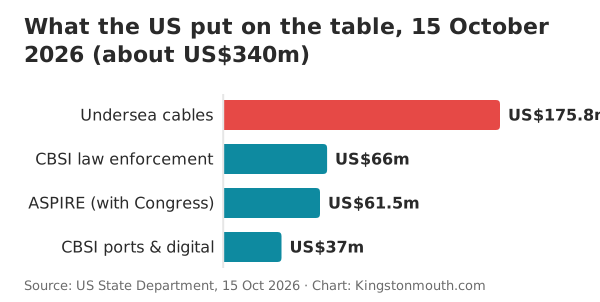
The headline number deserves a closer look. The State Department's own media note lists four sums:
- US$175.8 million for a Caribbean and Central America undersea cables programme, for "trusted" high-speed connectivity.
- US$61.5 million, which the Department "intends to provide" with Congress, for a health workforce scheme called ASPIRE.
- US$37 million under the Caribbean Basin Security Initiative (CBSI) to secure digital infrastructure and ports and to counter illegal fishing.
- US$66 million in CBSI law enforcement and security support, made up of US$55 million in narcotics and law enforcement aid and US$11 million in Foreign Military Financing.
That adds up to about US$340 million, the figure The Gleaner reported, not US$400 million. More than half of it is for undersea cables shared with Central America. Around US$103 million is for security. And there is no line for the resilient energy systems that CARICOM put first. A Caribbean Investment Summit is promised for early 2027 and a CBSI security ministerial for spring 2027, but neither carries money yet.
Mr Landau was frank about where Washington's interest lies: "The American private sector is going to have more creative, cost-effective solutions for the problems you're looking at than the U.S. Government will." The Gleaner, for its part, described the package as a direct effort to counter China's footprint in the region.
The Case for Partnership
Supporters can point to real gains. Mr Landau spoke directly about guns. He said one of his first tasks in office was an article about weapons moving to Haiti from the Miami River, and he offered the help of the US Attorney's Office in Miami to Caribbean governments facing trafficking networks. For Jamaica this is not abstract. According to ATF trace data for 2025, summarised by Global Action on Gun Violence, 90.3 per cent of 946 traced firearms recovered in Jamaica came from the United States. The US Government Accountability Office found that 73 per cent of crime guns traced in the Caribbean between 2018 and 2022 came from the US, and that Jamaica lacked the personnel and equipment to search the volume of shipments arriving.
Port security money and a promise of regular dialogue are better than the neglect Mr Landau himself admitted to.
The Case for Caution
Critics counter that the dialogue sits inside a wider pattern of pressure. On 13 October, two days before the Washington meeting, Jamaica received its first 22 third-country deportees from the US under an agreement signed in June. The government says it is a transit arrangement, not funded by Jamaica, and that people with criminal records will not be accepted. Yet the agreement itself remains secret. Foreign Affairs Minister Kamina Johnson Smith said: "Some countries have had their agreements made public, but our partner has not agreed for this one to be." In our view, an agreement that the Jamaican people are not allowed to read is a poor foundation for trust.
The health money carries a message too. ASPIRE promises to help governments hire health professionals "ethically and transparently, with fair pay going to the workers themselves". The Gleaner noted that this follows several CARICOM states ending decades-old ties with Cuba's medical programme, a move critics say was made under US visa pressure. Washington announced visa restrictions on officials linked to Cuba's overseas medical missions in February 2025, and Mrs Johnson Smith said then that Jamaica had "quite a long history of participation" in that programme.
Then there are the diaspora's pockets. Since the start of this year, a 1 per cent US excise tax applies to remittances sent in cash, money orders and similar instruments. The Gleaner estimated that Jamaica receives roughly US$3.3 to US$3.5 billion a year in remittances, equal to 17 to 20 per cent of GDP. And over all of it hangs the US military action in Venezuela in January, after which the CARICOM Bureau called for "peaceful dialogue through diplomatic channels". A region that prizes peace and international law cannot simply ignore what happens on its own doorstep.
The Missing Piece: Climate and Energy
Ambassador Byron Blake, a former CARICOM assistant secretary-general, put it plainly to The Gleaner. If he were advising Caribbean leaders, he said, one of their most critical requirements is "the hardening of infrastructure against climate risk". He also called the health initiative's focus "much too narrow", arguing for training health workers "in numbers" so the region does not have to recruit from abroad.
We agree. For Jamaican households, as Mr Pierre said, "energy security means affordable electricity". Fibre-optic cables matter, but they do not lower a JPS bill or rebuild a roof after a hurricane. Small island states did not cause the climate crisis, and a partnership that funds ports and policing while leaving energy and climate resilience to a future investment summit is, in our view, upside down.
Haiti Cannot Wait
Haiti was at the table, and that matters. On 29 September the UN Security Council extended the Gang Suppression Force for six months, to 31 March 2027, instead of the two years the force had asked for. Mr Pierre welcomed the extension and called for "credible elections with the widest possible participation". The test now is whether the Miami pledges become prosecutions and seizures that Haitians can see.
What Jamaica and CARICOM Must Insist On
For us, the dialogue will only be worth having if the region leaves with more than announcements. We believe Jamaica and CARICOM should insist on five things before the 2027 meetings:
- Energy and climate money, not just cables. A specific, funded commitment for renewable and resilient power, as CARICOM asked in its own opening statement.
- Gun trafficking measured in results. Published figures each year on US prosecutions and seizures of weapons bound for Jamaica and Haiti, not just programme budgets.
- Transparency on deportation deals. The Jamaican agreement should be laid before Parliament. If Washington will not publish it, Kingston should explain why it signed.
- Fair terms for the diaspora. A clear CARICOM position on the remittance tax, and joint work on visa access so that students, workers and families are not caught in other quarrels.
- Sovereign health choices. Support for training Caribbean health workers at scale, without forcing governments to choose between Washington and Havana.
Our Verdict
The US–Caribbean Dialogue is not charity and it is not an insult. It is leverage dressed as partnership, and it can still become a real partnership if the region negotiates as a bloc and keeps score. Mr Pierre said it best: "The strength of today's meeting will be demonstrated by what follows it."
Jamaica should hold Washington to that standard, and hold its own government to it too. Ordinary Jamaicans will judge this process not by the size of the cheque announced in Washington, but by cheaper electricity, fewer guns on our streets and fair treatment for our families abroad. Our leaders, JLP and PNP alike, must keep that list in front of them.
Annieth Woollery is a contributing writer for Kingstonmouth.com. Kingstonmouth.com has published independent commentary on Politics, Human Rights and International Development for over ten years. Readers wishing to comment may contact us at kingstonmouth63@gmail.com or on our Facebook and X pages.
Sources
- United States Hosts Caribbean Dialogue to Advance Shared Security and Prosperity — U.S. Department of State, 16 October 2026
- Deputy Secretary of State Christopher Landau With Saint Lucia Prime Minister and CARICOM Chair Philip J. Pierre at the Opening Remarks of the U.S.-Caribbean Dialogue — U.S. Department of State, 15 October 2026
- US$340m Caribbean push — Jamaica Gleaner, 20 October 2026
- U.S. Launches Caribbean Dialogue with $400 Million in New Commitments — Forth, October 2026
- Jamaica accepts first flight of third-country deportations from US — Al Jazeera, 14 October 2026
- New ATF trace data on Mexico, Canada and the Caribbean — Global Action on Gun Violence, 26 August 2026
- High Murder Rates in the Caribbean Linked to Guns Trafficked from the United States — US GAO, 20 November 2024
- Impending US tax on remittances expected to impact Jamaican households and businesses — Jamaica Gleaner, 4 July 2025
- Jamaica concerned about US visa restrictions over Cuban medical missions — Caribbean National Weekly, 5 March 2025
- CARICOM calls for peaceful dialogue after US military action in Venezuela — The Voice, 6 January 2026
- UN extends Haiti's Gang Suppression Force mandate to March 2027 — The Haitian Times, 29 September 2026