
Ballots and Drones: can Haiti vote its way out while others fight its war?
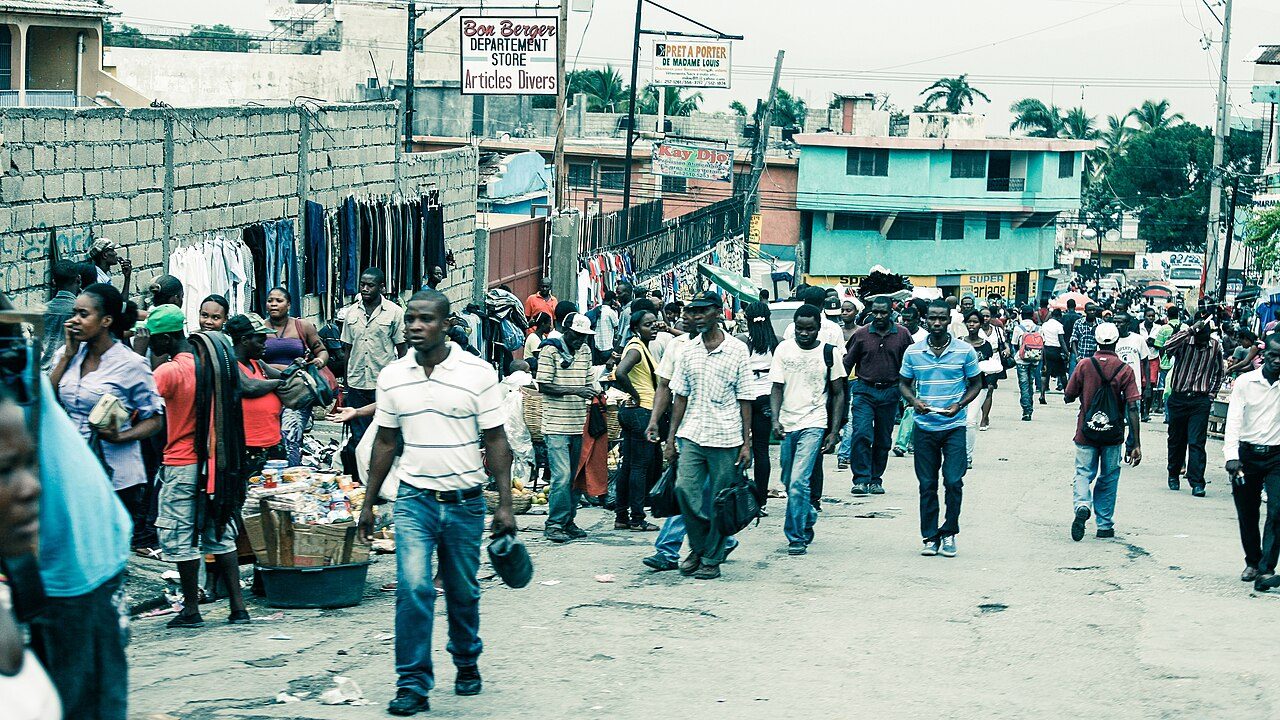
On Sunday, 15 November, registration closed for candidates in Haiti's presidential and parliamentary elections. The Associated Press (AP) reports that 33 people have put their names forward for president: 30 men and, for the first time in Haiti's history, three women. More than 100 political parties have registered. If the vote goes ahead, it will be the country's first general election in more than a decade.
That is good news, and the Caribbean should say so. Yet the same AP report describes a country where gangs are still fighting the police, the army, a United Nations-backed force, a private security firm and about 2,500 soldiers from El Salvador. At Kingstonmouth.com, we ask the real question: can Haiti hold an election that Haitians will trust while a war is being fought in its streets by forces whose rules nobody has published?
Recent Developments
Haiti has had no president since Jovenel Moïse was killed at his home in July 2021. Since then, according to AP, it has been led by appointed prime ministers and by a transitional presidential council that was dissolved in February this year.
The Provisional Electoral Council is now reviewing the candidates and expects to publish a final list in January. Haiti hopes to hold the first round on 18 July 2027 and the second on 4 October.
That timetable has already slipped once. When the CARICOM Eminent Persons Group (EPG) visited Haiti from 2 to 9 September, its statement spoke of a first round "scheduled for 13 December 2026". Even then, the EPG recorded that a number of parties wanted changes to the rules that "might necessitate a deferment", and that voter registration "was not meeting expectations".
The field itself is wide. AP's list of high-profile candidates includes Martine Moïse, the widow of the murdered president; the economist Etzer Emile; former foreign minister Dominique Dupuy, one of the first women ever to register; and former president Michel Martelly, who AP notes was sanctioned by Canada in 2022 and by the United States in 2024. Voters will have real choices. Whether they will also have a safe way to make them is another matter.
The Numbers Problem
Candidates are only half of an election. The other half is the voters' list, and here the figures are worrying.
Wolf Pamphile, founder of the think tank Haiti Policy House, told AP that nearly a million voters have been registered in a country of nearly 12 million people. The government, he said, has set a benchmark of between 3 million and 6 million voters for an election to be considered legitimate. "That number is getting harder and harder to reach," he said. Registration has slowed from roughly 9,000 people a day at the start to about 3,000 a day.
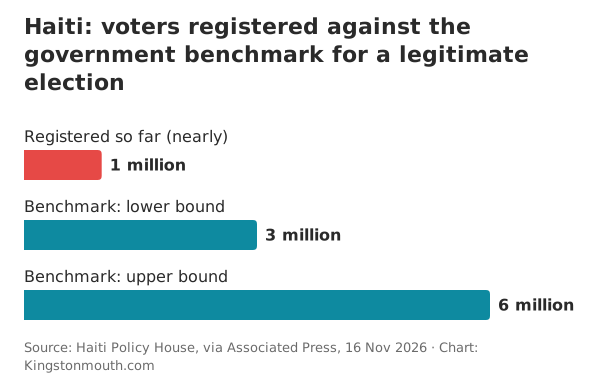
The EPG explained why in September. Registration, it said, was "constricted by the existence of territories beyond state control". AP reported earlier this month that gangs control 70 per cent of Port-au-Prince. People who cannot safely reach a registration centre cannot register, and people who cannot safely reach a polling station will not vote.
A Crowded Battlefield
Security is supposed to be the answer to that problem. It is also where the hardest questions lie.
The UN Security Council has authorised a Gang Suppression Force (GSF) of up to 5,550 personnel. Roughly 2,000 are on the ground, according to an analysis by security researcher Robert Muggah published in The Conversation and The Haitian Times. Jamaica is one of six countries that The Haitian Times listed in September as contributing troops and police, alongside Chad, El Salvador, Guatemala, Mongolia and Sri Lanka. The force's mandate runs only until 31 March 2027, months before the planned vote.
Then, on 18 October, four Salvadoran aviation technicians attached to the GSF went missing in a gang ambush. President Nayib Bukele responded by sending about 2,500 troops, with armoured vehicles and attack helicopters. The UN has said that most of those personnel are not operating under the framework of the GSF.
The tempo of the fighting has changed. On 6 November, Mathias Saintil, head of the "Boston" gang in Cité Soleil, was killed in a drone strike by a Haitian task force. On 10 November, Mr Bukele posted footage of helicopters firing on a compound linked to the leader of the 400 Mawozo gang; Mr Muggah writes that as many as 20 people were killed, and that the gang leader was reportedly absent. An analyst with the Armed Conflict Location & Event Data Project told AP that clashes and drone strikes rose by 46 per cent after the Salvadoran deployment, compared with the 21 days before it. Estimated deaths in those operations have passed 100, with more than two dozen identified as civilians.
Who Answers When Things Go Wrong?
Supporters argue that Haitians have waited long enough. Mr Muggah notes that almost 6,000 people were killed in 2025 and nearly 1.5 million had been displaced by August this year, and that crowds have cheered Salvadoran soldiers. Prime Minister Alix Didier Fils-Aimé, speaking on 3 November, thanked Mr Bukele and insisted that Haiti is in charge. "The international force is not here to replace the state," he said. "They're here to support us."
Critics counter that nobody outside the two governments knows the terms. "We still do not know the terms of the agreement with the Haitian government, who commands these troops, under which rules of engagement, or for how long," Romain Le Cour of the Global Initiative Against Transnational Organized Crime told AP. He counted five separate security structures on the ground and called the result "an orchestra without a conductor". According to AP, Amnesty International has called on both governments to publish the agreement, and US Secretary of State Marco Rubio has said Washington is "not actively involved".
The record on explosive weapons is already troubling. Mr Muggah cites figures showing at least 1,243 people killed in 141 drone operations between March 2025 and January 2026, among them at least 60 people reportedly unconnected to gangs, 17 of them children. In our view, both sides of this argument are right. Haitians deserve relief from the gangs, and they deserve to know who is accountable when a strike kills the wrong people. As UN spokesman Stéphane Dujarric put it: "People's rights need to be respected as you conduct security operations."
What This Means for Jamaica and CARICOM
Haiti is a full member of CARICOM, and Jamaica has personnel in the UN-backed force. This is our business. In September the EPG called on international partners to deliver "with despatch" on their security commitments, and it was right. But the situation has changed since then, and in researching this article we found no public CARICOM statement on the Salvadoran deployment.
There is also an electoral risk. Writing in Americas Quarterly, an adviser on elections who has worked with the UN, the EU and the OAS warns that a prolonged Salvadoran deployment with no clear timetable could raise questions about its neutrality during the campaign. Mr Bukele faces his own election in February; Mr Fils-Aimé's government is organising Haiti's. Foreign firepower and domestic politics are a dangerous mix.
The Way Forward
For us, three things follow. First, CARICOM should welcome the candidates and the parties, and say plainly that the July 2027 date must be earned through registration, not announced and then allowed to slip, as December did. Second, the region should add its voice to the call for Haiti and El Salvador to publish their agreement: who commands, under what rules, and for how long. Third, Jamaica and its partners should press the Security Council to settle the GSF's future well before March, so that Haitians are not asked to vote in a security vacuum.
Haiti has gone more than five years without a president. This week, 33 of their fellow citizens stepped forward to lead them. The least the Caribbean family can do is insist that the war being fought in their name is fought by rules they are allowed to read.
Produced with AI assistance and reviewed by the Kingston Mouth editorial team. Kingstonmouth.com has published independent commentary on Politics, Human Rights and International Development for over ten years. Readers wishing to comment may contact us at kingstonmouth63@gmail.com or on our Facebook and X pages.
Sources
- Haiti revs up for elections as enrollment closes for presidential and parliamentary candidates — Associated Press (via WSLS), 16 Nov 2026
- Haiti's prime minister Fils-Aimé speaks out as concerns over El Salvador's troops deepen — Associated Press (via ClickOnDetroit), 3 Nov 2026
- Bukele makes political gamble with Haiti gang offensive ahead of El Salvador's election — Associated Press (via Border Report), Nov 2026
- El Salvador exports Bukele's security model to Haiti amid gang crisis — Robert Muggah, The Conversation (via The Haitian Times), 14 Nov 2026
- Statement from the CARICOM Eminent Persons Group: visit to Haiti, 2–9 September 2026 — CARICOM Secretariat, Sep 2026
- UN extends Haiti's Gang Suppression Force mandate to March 2027 amid rising violence — The Haitian Times, 29 Sep 2026
- El Salvador's presence and a gang's offer test Haiti's security — Americas Quarterly, Nov 2026
Get Kingston Mouth in your inbox
Donovan Reynolds' latest articles and videos on Jamaica, the UK and the world, plus occasional sponsored offers. Unsubscribe any time.
Enjoyed this? Kingstonmouth.com is independent and reader-supported.
☕ Buy us a coffee
Comments
Loading comments…
Leave a comment